Hydraulic guillotine shear
Linear upper-blade movement with an adjustable cutting geometry to review.
- Linear blade travel
- Blade-clearance adjustment
- Rake-angle setup

Hydraulic guillotine and swing-beam shears for straight sheet and plate cutting.
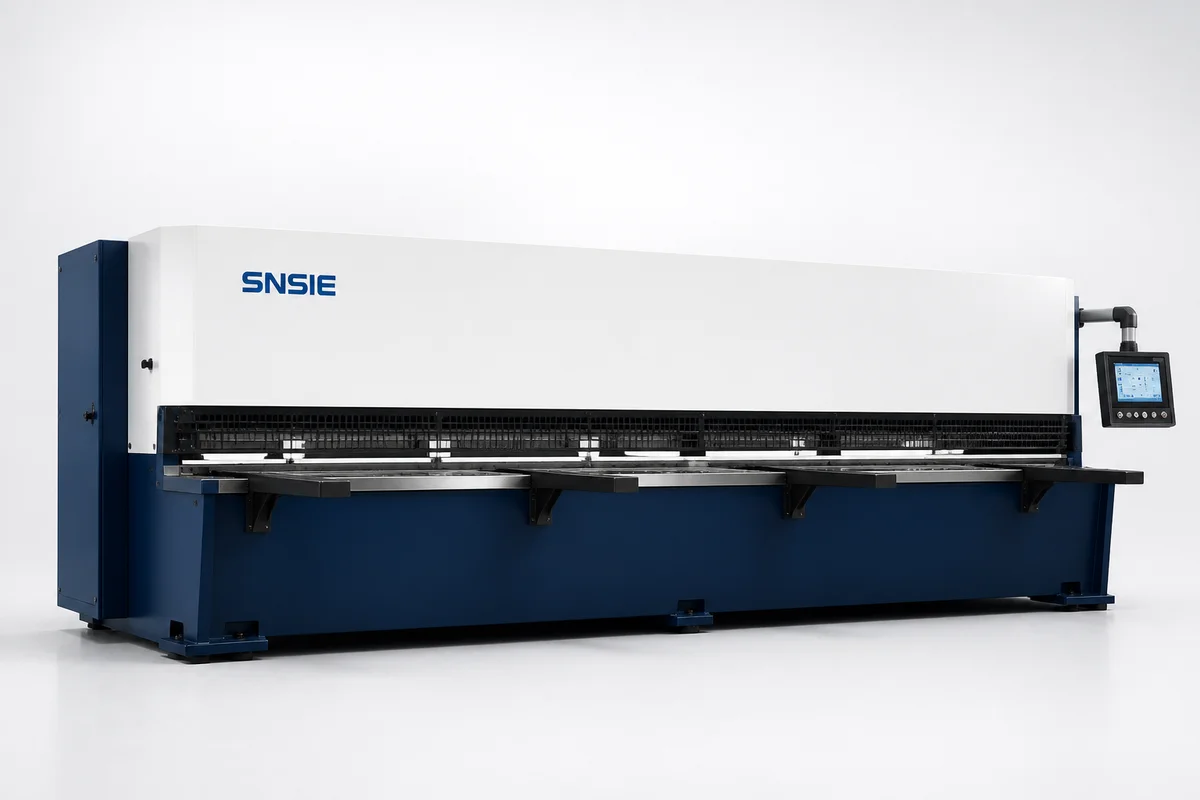
Straight cuts are made between upper and lower blades. Clearance, hold-down force, sheet support and backgauge positioning influence edge quality and dimensional consistency.
Linear upper-blade movement with an adjustable cutting geometry to review.
A pivoting upper cutting beam for everyday sheet preparation.
Specify cut length, material strength and thickness. Review blade clearance, rake angle, strip distortion and how blanks are supported and collected.
Discuss your application →Steel, stainless steel and aluminum sheet. Every thickness rating must state its material-strength basis.
Use these fields to compare a proposed machine against your material, drawings and production needs.
| Specification | What to confirm |
|---|---|
| Capacity | Thickness by material and maximum cut length. |
| Blades | Rake angle, clearance and blade material. |
| Positioning | Backgauge travel and sheet squaring. |
| Handling | Front/rear support and blank collection. |
Working capacities and available options depend on the selected model. Request a technical sheet for your material and part.
Request specifications →Specify cut length, material strength and thickness. Review blade clearance, rake angle, strip distortion and how blanks are supported and collected.
Start with the required process and part drawings, then review the capacity, tooling, control and installation details of the proposed model. Include representative parts when production quality or cycle time is critical.
Share your sheet-metal processing requirements with SNSIE.